Chelation Therapy is effective in that it is able “to grab” or “to bind” heavy metals such as mercury, lead, arsenic, and aluminum, to name a few, and remove them from the body.
In 2019 it was discovered that Canadian tap water contained high levels of lead. According to Health Canada and the World Health Organization (WHO), there is no safe level of lead exposure.
Individuals who live in areas abundant in industry, farming, and natural resource extraction, such as Alberta, may be exposed to higher levels of environmental toxicants. Exposure to these toxicants such as lead, mercury, and cadmium can cause a myriad of symptoms and diseases.
They do this by accumulating in the body and producing “free radicals”. Free radicals are molecules that are highly reactive and cause damage to your cells. Higher amounts of toxicants in the body tend to create more free radicals in the body which in turn are more likely to cause disease and dysfunction.
There is a way to test and assess the overall burden of these toxicants in the body. There is also a way to reduce the amount of many of these toxicants in the body. This can be done through a procedure known as chelation therapy.
Optimum Wellness Integrated clinic, under the direction of Dr. A.J. DeNault B.Sc. Pharmacy, ND, has been providing chelation therapy in the Edmonton area for 25 years. Optimum Wellness Integrated clinic has administered thousands of chelation IVs to patients with good results. We have one of the largest IV rooms in Western Canada. Our IV room has a full nursing staff and is overseen by multiple naturopathic doctors. We also use infusion pumps to ensure the safety and efficacy of our treatments.
Exposure to toxicants in the environment, and even some medical treatments may cause harmful compounds to build up faster than the body can eliminate them. These compounds can accumulate in the body. They accumulate in certain tissues and the body’s detoxification systems cannot get rid of them, especially toxic heavy metals.
When these toxicants accumulate in high enough amounts they may cause health issues. Chelation therapy may be the only way to remove these toxic heavy metals from your body.
Chelation stems from a Greek word that means “to claw” or “to grab”. Chelation therapy involves the administration (either I.V. or oral) of compounds that bind to and remove toxic heavy metals, toxicants, and other undesirable compounds from the body.
Common chelating agents are EDTA and DMSA. Chelation can be used to remove many toxic heavy metals, some of which are: aluminum, arsenic, cadmium, lead, mercury, etc., from the body. Read more about Mercury Chelation.
Excess heavy metals are also known to cause neuro-degenerative diseases such as neuritis, multiple sclerosis, Alzheimer’s disease and other diseases that plague modern mankind.
By removing heavy metals, free radical damage is significantly reduced or reversed.
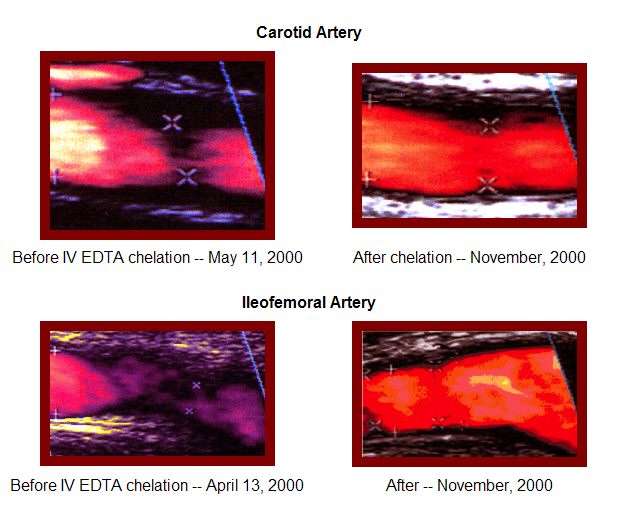
One of the ultimate effects of chelation therapy is to restore the health of the arteries. This is obtained by the removal of the pathological heavy metals and the increased production of a naturally formed substance called nitric oxide.
Current research now validates nitric oxide as an endothelial-relaxing factor that relaxes the blood vessels, decreases the resistance to blood flow, and subsequently improves the delivery of oxygen and other vital nutrients that the vessels supply to the tissue.
Such effects are desirable in a majority of cardiovascular diseases.
I.V. Chelation Therapy may have positive benefits in the treatment of the following disease processes:
Individuals who live in areas abundant in industry, farming, and natural resource extraction, such as Alberta, may be exposed to higher levels of environmental toxicants. Exposure to these toxicants such as lead, mercury, and cadmium (to name a few) can cause a myriad of symptoms and diseases. These three toxicants are also known as “toxic heavy metals”.
They do this by accumulating in the body and producing “free radicals”. Free radicals are molecules that are highly reactive and cause damage to your cells. Higher amounts of toxicants in the body tend to create more free radicals in the body which in turn are more likely to cause disease and dysfunction.
Today we know that mercury is the most toxic nonradioactive heavy metal on the planet, many times more poisonous than arsenic, lead, or cadmium. The tiniest amount of mercury once absorbed by the body can inflict widespread damage to cells, tissues and organs. As mercury is carried by the blood to the cells of the body, its effects can be detrimental in several ways.
As for lead, according to Health Canada and the World Health Organization (WHO), there is no safe level of exposure.
How can these toxic heavy metals affect our bodies
Some common symptoms of chronic mercury & lead toxicity include:
Testing
There is a way to test and assess the overall burden of toxic heavy metals in the body.
Doctors at our clinic order a special heavy metal urine test for our patients, available from the USA, which tests for most of the toxic heavy metals.
Treatment
The treatment for the removal of toxic heavy metals involves the administration of intravenous (IV) chelation therapy or oral chelation therapy. Intravenous (IV) chelation therapy is many, many times more effective than oral chelation therapy, and is more commonly used at our clinic.
Each patient is encouraged to read books on Chelation which are available at major bookstores or online. Our clinic carries copies of Forty Something Forever, A Consumer’s Guide to Chelation Therapy by Harold & Arline Brecher, and Bypassing Bypass Surgery by Elmer M Cranton, M.D.
The “specific” chelating agent is determined based on the types of toxic heavy metals that have been found in your body. Certain chelating agents are better than others at removing certain toxic heavy metals from your body. If multiple toxic heavy metals have accumulated in your body, you may have to receive multiple different chelating agents. These agents will usually be administered at different times. It is recommended to go through an entire cycle of one chelating agent before switching to another chelating agent.
After careful assessment including a physical exam and laboratory testing, Chelation therapy is given by intravenous drip (I.V.) to a maximum frequency of three treatments per week. Each treatment takes about 2½ hours and is given with the patient seated in a comfortable recliner chair, in which they can read or visit with their neighbor. Depending on the patient’s condition, it is usually recommended that an initial course of 20 to 30 weekly or bi-weekly treatments be taken. After that, monthly booster treatments are recommended to maintain the benefits originally gained by the first series of treatments.
The amount of chelating agent administered is carefully calculated according to each patient’s age, weight, sex, general health and blood creatinine levels according to the A.C.A.M. protocol (American College for Advancement in Medicine). If above normal blood creatinine levels are detected, the dosage and frequency of treatment will be reduced. Treatment may be stopped if in judgment of the doctor, continuing them might present any type of potential problem for the patient.
Reaction to the chelating agent or to the vitamins included in the I.V. treatment does occur occasionally. This is usually avoided by starting with smaller doses and gradually building up to desired levels. Inflammation at the site of the I.V. may occur and is treated with cold compresses. If your blood pressure or blood sugar declines with treatment it is suggested that you see your regular doctor to adjust your prescription medicines. A drop in blood calcium occasionally occurs and is evident by muscle twitching, but this is corrected with I.V. or oral calcium.
Patients with heart failure are monitored closely as too much fluid can cause problems. Kidney damage leading to dialysis is rare, whereas if there is a modest kidney damage before Chelation, kidney function often improves. Life threatening reactions are also rare. Chelation cannot be given to people with severe kidney damage, to people on high doses of blood thinners or to pregnant women.
Yes, very safe. Over 1 million people world-wide have been chelated and there are no reported deaths from EDTA Chelation in the last 20 years following the A.C.A.M. protocol which is followed in our clinic. However fatality as in any medical or surgical treatment must be considered.
EDTA Chelation treatments remove heavy metals, thereby reducing chest pain (angina) and improving circulation throughout the body. In most cases, EDTA Chelation therapy improves the patent’s quality of life without requiring surgery.
Although many people gain the same or better benefits from EDTA Chelation as compared to Bypass or Peripheral-vascular surgery, it must be pointed out that EDTA Chelation and surgery may not be mutually exclusive. In cases where surgery is required, EDTA Chelation can be used thereafter to improve and maintain the surgery’s benefits.
Chelation therapy is part of a comprehensive program. It is enhanced when used with a total nutritional program including professional supplements, and the adaptation of a “Heart-Smart” diet. Other lifestyle modifications that are encouraged are exercise, stress management, minimal use of caffeinated and alcohol beverages and the elimination of tobacco products.
Some nutritional “oral” supplements which contain EDTA or other chelation agents like DMSA have recently been alleged to be as effective as “intravenous” Chelation therapy. However the truth is that with oral chelation agents is that only 5 to 10% or less of the chelating agent is absorbed from the digestive tract when taken orally. Rectal chelation suppositories also have a low amount of absorption. The remainder passes out in the stool. Oral chelation must also be taken every day to absorb an effective amount of EDTA and when taken on a daily basis, oral EDTA binds essential nutrients in the digestive tract and blocks their absorption, causing nutritional deficiencies.
When EDTA is given intravenously there are no absorption issues. Furthermore, nutritional “oral” supplementation taken during the I.V. Chelation program more than compensates for any losses incurred during the I.V. therapy.
Chelation is not covered by Alberta Health Care. Some private (work) insurance companies may cover part of the therapy costs, however our clinic does not provide any third party billing. After each treatment our clinic provides each patient with an invoice for either their insurance coverage or their personal files.
Please be aware that individual responses to treatments may vary. Results are not guaranteed. Speak with your naturopathic doctor about the appropriate treatment plan for your case.